Mining, Drilling & Tunnelling
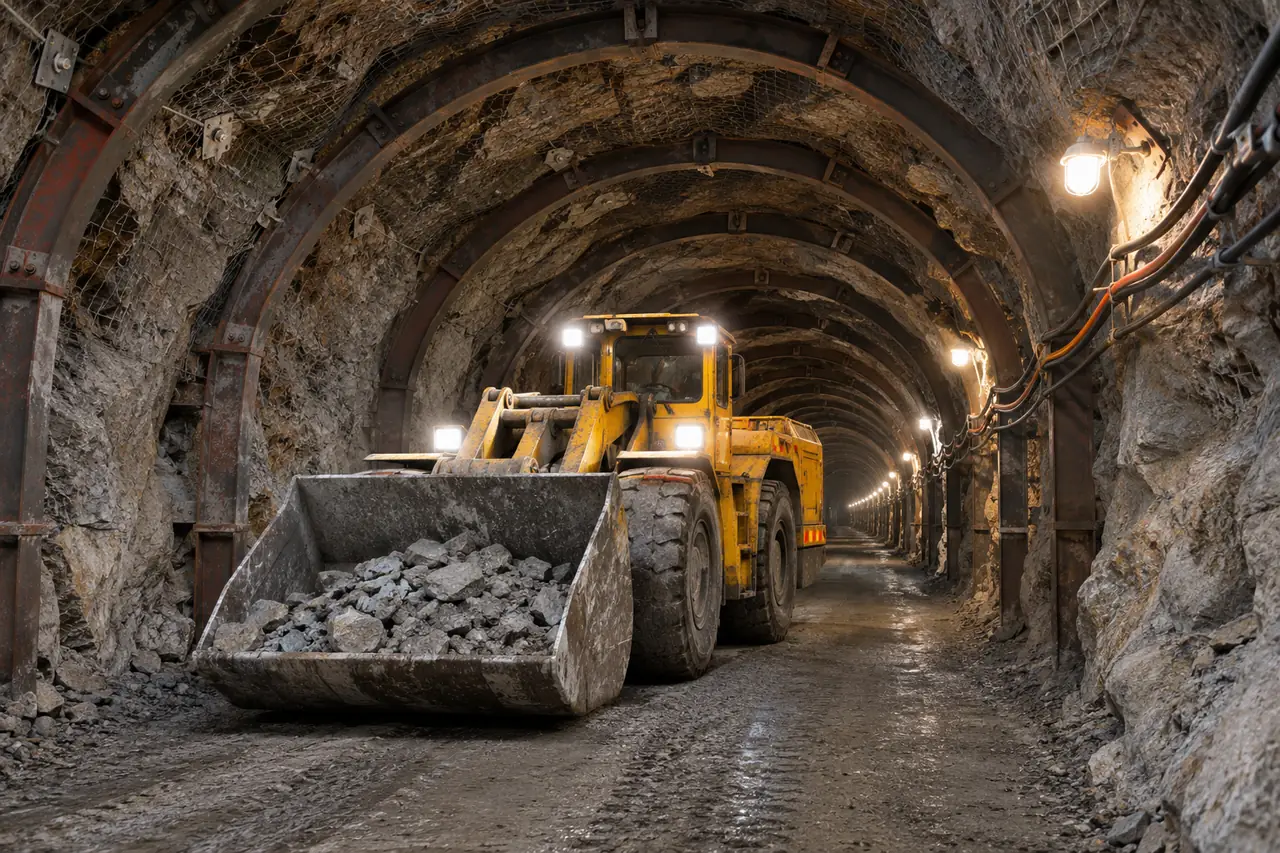
Mine and tunnel networks include fixed distribution feeders and separate flexible cables for moving equipment. Armour, screening and sheath construction vary with the route and mechanical duty.

Cable Application
Prysm Cable’s BS6708 range covers Type 20 armoured equipment cable, Type 7 and 7M screened constructions, and Type 307 cable. Separate armoured mains and instrumentation ranges serve fixed site distribution and monitoring.
Application Detail
Mine and tunnel networks include fixed distribution feeders and separate flexible cables for moving equipment. Armour, screening and sheath construction vary with the route and mechanical duty.
Type 20 provides an EPR-insulated, steel-wire-armoured construction with a chloroprene outer sheath for the mining-equipment cable specification.
Type 7 and 7M provide phase-screened mining constructions. The pilot-screen arrangement is a meaningful difference between these two ranges.
Type 307 is a separate EPR-insulated mining range with screened construction and a chloroprene sheath. Its complete voltage designation must match the equipment specification.
 BS6724 Mains Cable - SWA, LSZH, 1kV
 PAS5308 Part1/Type2 Instrumentation Cable, Individually Screened - LSZH
BS6724 armoured LSZH mains and armoured PAS5308 instrument pairs provide separate routes for fixed power distribution and site measurement circuits.
Application Detail
Both ranges use tinned-copper/nylon braid screens over the phase cores. Type 7M also screens the pilot; Type 7 explicitly leaves the pilot unscreened. If the equipment cable schedule calls for a screened pilot, that is a specific reason to distinguish 7M from Type 7.
A mining-equipment cable and an armoured fixed feeder can share a rugged appearance but have different assemblies and operating duties. Use the equipment’s required BS6708 type for its connection; treat the site power and instrument network as their own cable groups.
Application Detail
View specifications or add cables to your enquiry.

640V to 1100V · Heavy duty chloroprene outer sheath
BS 6708 Type 20 cable for mining and quarry power connections. Flexible Class 5 tinned copper, EPR insulation and a heavy-duty chloroprene sheath are combined with galvanised pliable…

640V to 1100V · Heavy duty chloroprene outer sheath
Type 7 mining power cable with screened phase cores, an unscreened pilot and an uninsulated ground core. Flexible tinned copper, EPR insulation and a heavy-duty chloroprene sheath form…

640V to 1100V · Heavy duty chloroprene outer sheath
Type 7M mining cable for power connections requiring screens over both phase and pilot cores. It uses flexible tinned copper, EPR insulation and a heavy-duty chloroprene sheath, with…
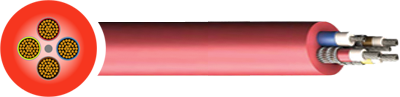
1900V to 3300V · Heavy duty chloroprene outer sheath
BS 6708 Type 307 cable for mining-machine power connections. Screened phase cores, an unscreened pilot and an uninsulated ground core are combined with flexible tinned copper, EPR insulation…
600/1000 Volts · Low Smoke Zero Halogen (LSZH)
Armoured copper mains cable for fixed 600/1000 V distribution circuits requiring LSZH bedding and sheath. The BS 6724 range combines XLPE insulation and steel-wire armour in sizes from…
300/500 Volts · Low Smoke Zero Halogen (LSZH)
Armoured instrumentation cable for measurement and control signals between field instruments, junction boxes and control panels. Each PE-insulated pair has a foil screen, and a collective screen surrounds…
Product Data
Print a product summary or download its listed construction and technical data as CSV.
Application Detail
“4 × 25 mm²” describes four conductors, each with a nominal area of 25 mm². It does not describe the cable’s outside diameter. Pair counts, conductor area and finished diameter each answer a different ordering question; mixing them up can produce the wrong cable or the wrong gland.
Read MoreA cable that can be bent into position is not automatically suitable for repeated machine movement. For a tight route, the useful numbers are the finished cable diameter, the minimum bending radius for that use, and the handling-temperature limit. Conductor class alone cannot answer all three questions.
Read More