
Cable Selection Guide
Will the Cable Fit the Bend and Survive the Movement?
A cable that can be bent into position is not automatically suitable for repeated machine movement. For a tight route, the useful numbers are the finished cable diameter, the minimum bending radius for that use, and the handling-temperature limit. Conductor class alone cannot answer all three questions.
Updated 7 November 2026
Calculate the Bend From the Finished Diameter
A minimum bending radius written as 5D means five times the overall cable diameter. D is the outside dimension of the complete cable, not its conductor area in mm². Armour, screens, insulation and sheath all contribute to that diameter.
For a cable with a 20 mm overall diameter and an applicable 5D limit, the radius is 100 mm. A radius is not the diameter of the bend circle: the full circle in this illustration would be 200 mm across. The cable also needs room to approach the bend and enter its gland or connector.
Flexible Enough to Install, or Designed to Keep Moving?
A fine-stranded Class 5 conductor helps a cable bend during routing and connection. Repeated travel in a cable chain adds a different duty: thousands or millions of bends, with a defined stroke, speed and bend radius. Torsion at a robot joint is another duty again.
LAPP distinguishes bending, torsion, and reeling because they stress cables differently. A flexible conductor by itself does not establish the complete cable’s life under any of those movements. The insulation, core assembly, screens and sheath must be suitable too.
Cold Handling and Fixed Service Are Different Conditions
A cable may remain in service at a low temperature yet need a warmer condition while being bent or moved. Mechanical stress during cold handling is the reason to distinguish these entries.
Our NSGAFÖU EPR/PCP range states −40°C to +90°C for fixed use and −25°C to +90°C when flexed. A proposed movement at −30°C therefore falls outside that stated flexed range even though it falls within the fixed range. That distinction can decide whether the cable is suitable for the job.
Match the Prysm Cable Range to the Duty
Our BS5467 power and control cable is an armoured fixed-wiring construction. The N2XH Class 5 LSZH range offers a flexible copper conductor and a stated minimum bending radius of 5D. The NSGAFÖU range combines flexible tinned copper, EPR insulation and a PCP sheath, with the separate fixed and flexed temperature limits above.
These give different starting points for a route or equipment connection. For continuous cable-chain travel or repeated torsion, the decisive evidence is a movement rating for the complete cable under that duty; the word “flexible” and a static bend figure do not provide it.
Cable Options in This Article
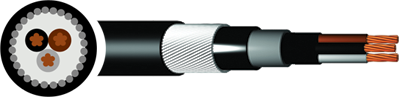
BS 5467 Armoured Power & Control Cable, 1.5–16 mm²
1.5–16 mm² · PVC (Polyvinyl Chloride)
Armoured cable for fixed power and auxiliary control wiring in factories, plant rooms and other industrial installations. This 1.5–16 mm² BS 5467 range combines copper conductors, XLPE insulation…
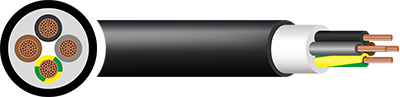
N2XH Class 5 Flexible LSZH LV Power Cable
600/1000 Volts · Low Smoke Zero Halogen (LSZH)
Flexible Class 5 copper power cable for equipment connections, with XLPE insulation and an LSZH sheath. This 600/1000 V range has a +90°C temperature rating and a minimum…
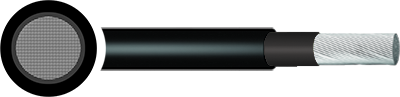
NSGAFÖU FLEXIBLE CABLE - EPR, PCP
1800/3000V · Polychloroprene (PCP)
Flexible NSGAFÖU cable for equipment-power connections, with tinned copper conductors, EPR insulation and a PCP sheath. The range is rated 1800/3000 V.
Technical References
- LAPP — Flexible cables for fixed and moving applications
- HELUKABEL — Separate fixed and flexible NSGAFÖU data
- Prysm Cable — BS 5467 Armoured Power & Control Cable, 1.5–16 mm²
- Prysm Cable — N2XH Class 5 Flexible LSZH LV Power Cable
- Prysm Cable — NSGAFÖU FLEXIBLE CABLE - EPR, PCP
- Eland Cables — Minimum Bending Radius
- Nexans — Applying a Cable Bending Radius
Related Reading
XLPE or LSZH? You May Need Both
A building specification can require XLPE insulation and LSZH bedding and sheath in the same cable. XLPE describes the insulation around the conductor; LSZH describes smoke and halogen-related characteristics. An XLPE/PVC cable therefore meets a different material requirement from an XLPE/LSZH cable.
Read MoreCable Size: Cores, Pairs, mm² and Outside Diameter
“4 × 25 mm²” describes four conductors, each with a nominal area of 25 mm². It does not describe the cable’s outside diameter. Pair counts, conductor area and finished diameter each answer a different ordering question; mixing them up can produce the wrong cable or the wrong gland.
Read More