
Cable Selection Guide
Cable Size: Cores, Pairs, mm² and Outside Diameter
“4 × 25 mm²” describes four conductors, each with a nominal area of 25 mm². It does not describe the cable’s outside diameter. Pair counts, conductor area and finished diameter each answer a different ordering question; mixing them up can produce the wrong cable or the wrong gland.
Updated 7 November 2026
Read the Count Before the Size
A multicore power cable groups insulated conductors. An instrumentation cable can group conductors into pairs or triples as well. Four cores and two pairs both involve four insulated conductors, but the pair construction is significant for signal wiring.
In a pair cable, the grouping and twisting are part of the electrical arrangement. Replacing it with any four-core cable would retain the conductor count while losing the specified pair construction.
Swipe or scroll to compare the columns.
| Example | What It Describes | What It Is Used For |
|---|---|---|
| 4 × 25 mm² | Four conductors; 25 mm² nominal area per conductor | Core count and electrical conductor size |
| 2 pairs × 2 cores × 0.75 mm² | Two pairs; each conductor has 0.75 mm² nominal area | Instrument circuit grouping and conductor size |
| Overall diameter 20 mm | Outside dimension of the complete cable | Gland, connector, route and bending-space selection |
Notation and dimensions here are reading examples, not a declaration that a particular Prysm Cable variant has these dimensions.
mm² Is Area, Not Diameter
Conductor size in mm² is a nominal cross-sectional area. The finished cable includes the insulation and any screen, bedding, armour and sheath. Two cables with the same conductor area can therefore need different glands and different space at a bend.
A stranded or shaped conductor adds another reason not to infer the finished diameter from the area. For accessory selection, the outside diameter and the gland’s clamping range have to match; the conductor area alone does not provide that fit.
Count the Protective Conductor and Drain Wire Correctly
Where a harmonised designation uses G for the core arrangement, it indicates that a green/yellow protective conductor is included in the count. For example, 4G2.5 means four cores in total, including the protective conductor, each with 2.5 mm² nominal area. It does not mean four working cores plus an extra earth.
In a screened instrument cable, the drain wire is a different component. Our PAS5308 individually screened LSZH range states a 0.5 mm² drain wire. That number describes the screen connection, not automatically the area of each signal conductor.
Where the Prysm Cable Ranges Divide
Our BS5467 armoured power and control range covers 1.5–16 mm², while the larger copper mains range covers 25–400 mm². Both use copper, XLPE insulation, steel-wire armour and PVC coverings. A schedule still needs the particular core arrangement and selected conductor area within the relevant range.
For an instrument schedule specifying pairs and individual screens, our PAS5308 Part 1 Type 1 LSZH range is the appropriate product family to examine. Retaining the pair count, signal-conductor size, screen arrangement and finished diameter keeps the electrical order and the accessory order aligned.
Cable Options in This Article
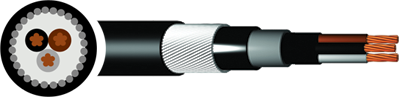
BS 5467 Armoured Power & Control Cable, 1.5–16 mm²
1.5–16 mm² · PVC (Polyvinyl Chloride)
Armoured cable for fixed power and auxiliary control wiring in factories, plant rooms and other industrial installations. This 1.5–16 mm² BS 5467 range combines copper conductors, XLPE insulation…
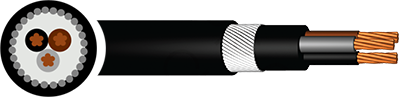
BS5467 Mains Cable - SWA, PVC, 1kV
1kV · Polyvinyl Chloride PVC
BS5467 armoured copper mains cable for fixed power distribution, in the 25–400 mm² range. XLPE insulation, steel-wire armour and a PVC sheath make up this 1 kV mains…
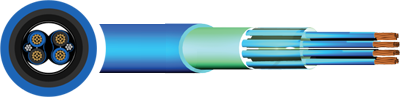
PAS5308 Part1/Type1 Instrumentation Cable, Individually Screened - LSZH
300/500 Volts · LSZH
LSZH-sheathed instrumentation cable with a separate screen around each PE-insulated copper pair. Each pair has a 0.5 mm² drain wire, providing individual screen connections for the 300/500 V…
Technical References
- IEC — Nominal areas and conductor requirements, IEC 60228:2023
- Eland Cables — Conductor shape and finished cable diameter
- Eland Cables — Pair count and conductor area in instrumentation data
- LAPP — Core Count and Protective Conductor
- Prysm Cable — BS 5467 Armoured Power & Control Cable, 1.5–16 mm²
- Prysm Cable — BS5467 Mains Cable - SWA, PVC, 1kV
- Prysm Cable — PAS5308 Part1/Type1 Instrumentation Cable, Individually Screened - LSZH
Related Reading
Copper or Aluminium Cable? Cost, Space and Installation
Copper is often the practical choice when cable space and equipment connections are tight. Aluminium is worth considering for larger fixed feeders when conductor cost and weight matter. A useful price comparison starts with cables sized for the same electrical duty, including the connections needed at each end.
Read MoreIndividual or Overall Screens for Instrument Cables?
An overall screen surrounds the complete group of pairs. Individual screens surround each pair, helping reduce coupling between circuits inside the cable. For several low-level analogue loops sharing one cable, the pair-by-pair separation can be the important difference. A screen around the outside cannot provide the same internal boundaries.
Read More