
Cable Selection Guide
XLPE or LSZH? You May Need Both
A building specification can require XLPE insulation and LSZH bedding and sheath in the same cable. XLPE describes the insulation around the conductor; LSZH describes smoke and halogen-related characteristics. An XLPE/PVC cable therefore meets a different material requirement from an XLPE/LSZH cable.
Updated 7 November 2026
Read the Layers Before Comparing the Offers
A quote for “XLPE armoured cable” leaves an important part of the construction unanswered. The conductor may be insulated with XLPE while the bedding and outer sheath are PVC. That is the arrangement in our BS5467 power and control range.
Where the project calls for LSZH bedding and sheath, our BS6724 power and control cable combines those outer materials with XLPE insulation and steel-wire armour. The practical question is which materials surround the cores, not whether XLPE and LSZH are competing names for the whole cable.
What XLPE Contributes
Cross-linking changes polyethylene from a thermoplastic into a thermoset insulation material. It improves its behaviour at higher temperatures while retaining its electrical insulating properties. That is why XLPE appears in many power-cable constructions, including both PVC-covered and LSZH-covered ranges.
The thermal capability of the insulation does not give one current rating for every installation. A cable surrounded by other loaded cables or installed in a hot, enclosed route cannot shed heat in the same way as a well-spaced cable in air. Conductor size and installation conditions still determine the usable rating.
What LSZH Adds to a Building Specification
Smoke can reduce visibility during evacuation, while acidic combustion gases can damage equipment as well as create hazards for people. LSZH compounds address smoke and halogen-related concerns. These requirements often matter on occupied building routes, particularly where many cables share an enclosed space.
Low smoke does not mean no smoke, and halogen-free material does not by itself establish that a circuit will keep operating in a fire. Smoke measurement and gas tests answer different questions from a circuit-integrity test. A life-safety circuit may need both the specified low-smoke materials and a separately defined fire-resistant cable system.
Cable Options in This Article
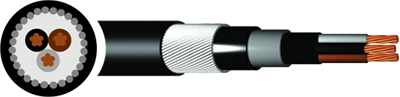
BS6724 Mains and Control Cable 1kV - XLPE, SWA, LSZH
600/1000 Volts · Low Smoke Zero Halogen (LSZH)
BS 6724 cable for fixed branch-power and auxiliary-control circuits requiring LSZH materials. Copper conductors, XLPE insulation and steel-wire armour are combined with LSZH bedding and sheath at 600/1000…
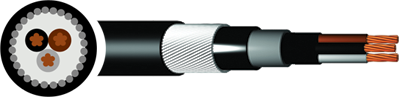
BS 5467 Armoured Power & Control Cable, 1.5–16 mm²
1.5–16 mm² · PVC (Polyvinyl Chloride)
Armoured cable for fixed power and auxiliary control wiring in factories, plant rooms and other industrial installations. This 1.5–16 mm² BS 5467 range combines copper conductors, XLPE insulation…
Technical References
- Prysm Cable — BS6724 Mains and Control Cable 1kV - XLPE, SWA, LSZH
- Prysm Cable — BS 5467 Armoured Power & Control Cable, 1.5–16 mm²
- Eland Cables — Benefits of XLPE Insulation
- LAPP — Halogen-Free Cable Materials and Test Scopes
- IEC — IEC 61034-1 Smoke-Test Apparatus and Scope
- IEC — IEC 60754-2 Gas Acidity and Conductivity
- Schneider Electric — Cable Sizing
- IEC — Circuit-Integrity Test Scope
Related Reading
Why Single-Core AC Cables Use Aluminium Wire Armour
For an individual AC phase, aluminium wire armour avoids the magnetic losses associated with steel armour around a single core. That is why our single-core 11 kV cable uses AWA, while the three-core 11 kV range uses SWA. The aluminium is in the armour; both of these ranges have copper power conductors.
Read MoreLSZH, Flame Retardant or Fire Resistant: Which Cable Does the Circuit Need?
An emergency circuit may need to keep working during a fire. An LSZH cable addresses smoke and halogen-related characteristics; a flame-retardant cable addresses flame spread. Neither label alone establishes circuit survival. Choosing the cable starts with the required function of the circuit during the fire.
Read More