
Cable Selection Guide
Copper or Aluminium Cable? Cost, Space and Installation
Copper is often the practical choice when cable space and equipment connections are tight. Aluminium is worth considering for larger fixed feeders when conductor cost and weight matter. A useful price comparison starts with cables sized for the same electrical duty, including the connections needed at each end.
Updated 7 November 2026
When Copper Is Worth the Extra Cost
Copper offers lower resistance for the same conductor area. That helps when a cable has to pass through an existing duct, turn into a crowded panel or connect to equipment with limited terminal space. An aluminium alternative may need a larger conductor, with a different finished cable diameter and termination arrangement.
This makes copper a sensible starting point for a replacement feeder in an existing installation. The question is whether the proposed aluminium cable can fit the route and the equipment without changing them. If it cannot, the cheaper cable can create extra work elsewhere.
When Aluminium Is Worth Pricing
Aluminium is lighter and usually costs less as a conductor material. Those advantages become useful on larger fixed feeder runs, especially where the route and terminations can be planned around the cable from the start.
The whole cable still includes insulation, armour and an outer sheath. A conductor-weight advantage is therefore not a promise that the finished cable will be the same percentage lighter. Compare the actual cable mass and dimensions for the two proposed sizes; these affect reel handling, pulling and the space occupied on the route.
Why the Same mm² Is the Wrong Price Comparison
Two offers marked 50 mm² describe the conductor area, not an equivalent feeder. At the same length and area, aluminium has higher resistance. At a given current, that means more resistive voltage drop and more I²R loss.
For example, Schneider Electric’s voltage-drop guide uses the estimates R = 23.7/S for copper and R = 37.6/S for aluminium, with S in mm² and R in Ω/km. Applied to one 100 m conductor, they give:
Swipe or scroll to compare the columns.
| Conductor | Calculation | Estimated Resistance |
|---|---|---|
| 50 mm² copper | 23.7 ÷ 50 × 0.1 | 0.0474 Ω |
| 50 mm² aluminium | 37.6 ÷ 50 × 0.1 | 0.0752 Ω |
| 70 mm² aluminium | 37.6 ÷ 70 × 0.1 | 0.0537 Ω |
This is a resistance illustration using the cited method, not a replacement-size schedule, current rating or Prysm Cable test result.
The Connection Can Change the Saving
An aluminium conductor needs a termination system suitable for its material, conductor form and size. Where it connects to copper equipment, that can mean an approved aluminium-to-copper connection, such as a compatible bimetallic lug. A copper lug already on the drawing is not automatically suitable for the alternative.
The change can also affect lug dimensions, crimping tools, cable glands and available bending space at the equipment. These are real parts and installation tasks. Including them in the alternative price gives a more useful answer than comparing cable cost per metre alone.
Compare the Installed Feeder, Not Just the Reel
Start with the two cable sizes that satisfy the circuit design, then put the associated costs beside each other: cable length and price, compatible terminations and glands, handling and pulling, any changes to the route or enclosure, and calculated losses during service.
Aluminium can be an attractive choice when a larger cable fits easily and the conductor saving outweighs the additional connection or installation costs. Copper can be the better purchase when keeping the installation compact avoids alterations. The answer will differ between a new, open cable route and a retrofit into existing switchgear.
Copper and Aluminium Mains Cables From Prysm Cable
Our BS5467 mains ranges include a stranded-copper option in the 25–400 mm² range and a solid-aluminium option in the 25–300 mm² range. Both have XLPE insulation, PVC bedding, steel-wire armour and a PVC outer sheath, with a 1 kV voltage designation.
For a building route requiring low-smoke, zero-halogen coverings, our BS6724 mains range uses LSZH bedding and sheath. That covering requirement is a separate choice from copper versus aluminium.
Cable Options in This Article
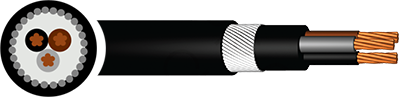
BS5467 Mains Cable - SWA, PVC, 1kV
1kV · Polyvinyl Chloride PVC
BS5467 armoured copper mains cable for fixed power distribution, in the 25–400 mm² range. XLPE insulation, steel-wire armour and a PVC sheath make up this 1 kV mains…
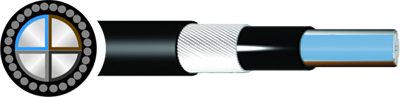
BS5467 Solid Aluminium Core Mains Cable - SWA, PVC, 1kV
1kV · Polyvinyl Chloride (PVC)
Solid-aluminium BS 5467 cable for fixed 1 kV mains and distribution circuits. The 25–300 mm² range has XLPE insulation, PVC bedding and sheath, and galvanised steel-wire armour.
Technical References
- Eland Cables — Copper and Aluminium Conductors
- Nexans — Aluminium Versus Copper
- Schneider Electric — Voltage-Drop Calculation
- Schneider Electric — Cable Sizing
- BASEC — Aluminium Conductors and Connections
- Prysm Cable — BS5467 Copper Mains Cable
- Prysm Cable — BS5467 Aluminium Mains Cable
- Prysm Cable — BS6724 LSZH Mains Cable
Related Reading
XLPE or LSZH? You May Need Both
A building specification can require XLPE insulation and LSZH bedding and sheath in the same cable. XLPE describes the insulation around the conductor; LSZH describes smoke and halogen-related characteristics. An XLPE/PVC cable therefore meets a different material requirement from an XLPE/LSZH cable.
Read MoreCable Size: Cores, Pairs, mm² and Outside Diameter
“4 × 25 mm²” describes four conductors, each with a nominal area of 25 mm². It does not describe the cable’s outside diameter. Pair counts, conductor area and finished diameter each answer a different ordering question; mixing them up can produce the wrong cable or the wrong gland.
Read More