
Cable Selection Guide
Why Single-Core AC Cables Use Aluminium Wire Armour
For an individual AC phase, aluminium wire armour avoids the magnetic losses associated with steel armour around a single core. That is why our single-core 11 kV cable uses AWA, while the three-core 11 kV range uses SWA. The aluminium is in the armour; both of these ranges have copper power conductors.
Updated 7 November 2026
The Problem with Steel Around One AC Phase
Alternating current produces a changing magnetic field around the conductor. Ferromagnetic steel around an individual phase can add magnetic losses and heating. Selecting a non-magnetic armour material addresses that problem while retaining wire armour around the cable.
In a three-core cable, the phases are grouped within the same armour. Their magnetic fields largely cancel under balanced operation, allowing the familiar steel-wire-armoured construction. Three separate single-core cables do not become one multicore cable simply because they run beside each other.
AWA Does Not Mean an Aluminium Power Conductor
AWA means aluminium wire armour. It says nothing by itself about the metal carrying the load current. Our BS6622 single-core 11 kV range has compacted copper conductors, XLPE insulation, copper-tape screening, AWA and a PVC sheath.
Confusing the armour metal with the conductor metal changes the electrical design unnecessarily. In an enquiry or comparison, “copper conductor, AWA” is a useful description: it identifies the load-carrying material and the mechanical armour separately.
The Armour Choice Does Not Finish the Circuit Design
Non-magnetic metal can still have voltage induced in it. With single-core cables, screen and armour bonding therefore need attention even when the armour is aluminium. Cable spacing, circuit length, load and bonding arrangement affect the result.
A bonded metallic loop can carry circulating current; a different bonding arrangement changes the induced-voltage and protection considerations. The correct arrangement belongs to the complete circuit design. “AWA” is not a reason to ignore bonding or to treat single-point and both-end bonding as interchangeable.
Single-Core and Three-Core 11 kV Options
Our BS6622 single-core AWA and three-core SWA ranges both have a stated rating of 6350/11000 V. The difference is how the phases and protective layers are arranged, rather than one option having an aluminium conductor.
A project specifying single-core circuits needs the appropriate cable formation, supports, accessories and bonding design. A project specifying a three-core assembly needs the corresponding three-core termination and handling arrangement. The two product ranges allow those designs to be priced as different cable systems.
Swipe or scroll to compare the columns.
| Feature | Single-Core AWA | Three-Core SWA |
|---|---|---|
| Power conductor | Copper | Copper |
| Voltage rating | 6350/11000 V | 6350/11000 V |
| Insulation | XLPE | XLPE |
| Metallic screen | Copper tape | Copper tape |
| Armour | Aluminium wire | Galvanised steel wire |
| Outer sheath | PVC | PVC |
Cable Options in This Article
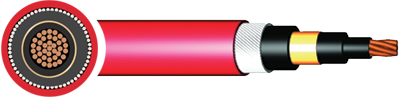
BS6622 Single Core Mains Cable 11kV - XLPE, AWA, PVC
6350/11000 Volts - Tested to Voltage and Duration of BS 6622 · PVC outer sheath
Single-core 6.35/11 kV cable for fixed links between switchgear, transformers and other distribution equipment. It combines compacted copper conductors, XLPE insulation, copper-tape screening and aluminium-wire armour, with PVC…
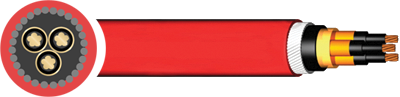
BS6622 3 Core Mains Cable 11kV - XLPE, SWA, PVC
6350/11000 Volts - Tested to Voltage and Duration of BS 6622 · PVC outer sheath
Three-core 6.35/11 kV cable for fixed distribution connections between switchgear, transformers and other power equipment. Compacted copper conductors, XLPE insulation and copper-tape screening are enclosed by steel-wire armour…
Technical References
Related Reading
XLPE or LSZH? You May Need Both
A building specification can require XLPE insulation and LSZH bedding and sheath in the same cable. XLPE describes the insulation around the conductor; LSZH describes smoke and halogen-related characteristics. An XLPE/PVC cable therefore meets a different material requirement from an XLPE/LSZH cable.
Read MoreIndividual or Overall Screens for Instrument Cables?
An overall screen surrounds the complete group of pairs. Individual screens surround each pair, helping reduce coupling between circuits inside the cable. For several low-level analogue loops sharing one cable, the pair-by-pair separation can be the important difference. A screen around the outside cannot provide the same internal boundaries.
Read More