
Cable Selection Guide
What 6.35/11 kV Means on an MV Cable
The two figures describe different electrical stresses: 6.35 kV from conductor to earth and 11 kV between phases. They are the U₀/U rating. A higher voltage used during a cable test is a separate test condition, not permission to operate that cable continuously on a higher-voltage network.
Updated 7 November 2026
Read Both Figures, Even When the Product Says “11 kV”
MV cables are often ordered using a shorthand network voltage such as 11 kV. The complete designation is more informative. U₀ refers to the rated conductor-to-earth voltage; U refers to the rated voltage between phases.
Our BS6622 three-core 11 kV range states 6350/11000 V. Written in kilovolts, that is 6.35/11 kV. Keeping both numbers on the comparison prevents “11 kV” from being mistaken for the conductor-to-earth rating.
What the Number in Brackets Means
Some designations add Um in brackets, for example 19/33 (36) kV. In that notation, 19 kV is the conductor-to-earth rating, 33 kV is the phase-to-phase rating, and 36 kV identifies the highest system voltage. The bracketed number is not a test voltage.
This helps when comparing datasheets that use different amounts of shorthand. Compare like fields with like fields: U₀ with U₀, U with U, and Um with Um where it is declared. The installation’s required rating and applicable cable standard still govern the selection.
Keep the Withstand Test in Its Own Column
A withstand test applies a defined voltage for a defined duration to assess the cable under the stated procedure. It is intentionally different from continuous service. Comparing one supplier’s test voltage with another supplier’s rated voltage would compare different quantities.
The useful comparison keeps service rating, test voltage, test method and duration separate. A larger test-voltage number does not convert an 11 kV cable into a 33 kV cable.
Our 11 kV and 33 kV Cable Ranges
For an 11 kV three-core arrangement, our BS6622 range uses copper conductors, XLPE insulation, copper-tape screening, galvanised steel-wire armour and PVC bedding and sheath, with a 6350/11000 V rating.
For a 33 kV single-core arrangement, our BS7870 service-cable range has a 19/33 kV rating, a copper conductor, XLPE insulation, copper-wire screening and an MDPE sheath. The voltage, core arrangement, screen and outer construction all change. Choosing between them is a network and installation decision, not a comparison of the largest number printed on the page.
Cable Options in This Article
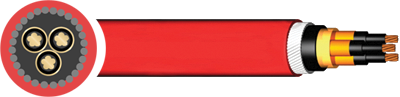
BS6622 3 Core Mains Cable 11kV - XLPE, SWA, PVC
6350/11000 Volts - Tested to Voltage and Duration of BS 6622 · PVC outer sheath
Three-core 6.35/11 kV cable for fixed distribution connections between switchgear, transformers and other power equipment. Compacted copper conductors, XLPE insulation and copper-tape screening are enclosed by steel-wire armour…
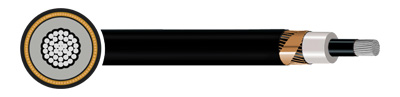
BS7870 Single Core Service Cable 33kV - XLPE, MDPE
Uo/U 19kV / 33kV · Medium Density Polyethylene (MDPE)
Single-core copper service cable for 19/33 kV network connections. The BS 7870 construction has XLPE insulation, a copper-wire screen and an MDPE outer sheath.
Technical References
Related Reading
XLPE or LSZH? You May Need Both
A building specification can require XLPE insulation and LSZH bedding and sheath in the same cable. XLPE describes the insulation around the conductor; LSZH describes smoke and halogen-related characteristics. An XLPE/PVC cable therefore meets a different material requirement from an XLPE/LSZH cable.
Read MoreWill the Cable Fit the Bend and Survive the Movement?
A cable that can be bent into position is not automatically suitable for repeated machine movement. For a tight route, the useful numbers are the finished cable diameter, the minimum bending radius for that use, and the handling-temperature limit. Conductor class alone cannot answer all three questions.
Read More