
Cable Selection Guide
LSZH, Flame Retardant or Fire Resistant: Which Cable Does the Circuit Need?
An emergency circuit may need to keep working during a fire. An LSZH cable addresses smoke and halogen-related characteristics; a flame-retardant cable addresses flame spread. Neither label alone establishes circuit survival. Choosing the cable starts with the required function of the circuit during the fire.
Updated 7 November 2026
An Alarm Circuit and an Ordinary Power Circuit Have Different Jobs
Ordinary building wiring distributes power in normal operation. A fire-alarm or other life-safety circuit may have to continue serving its equipment under specified fire conditions. The cable choice follows that required function.
For an alarm loop, a small screened fire-alarm cable can be the relevant construction. An essential power feeder may instead require a fire-resistant armoured mains cable. Substituting an ordinary LSZH wire simply because all three products have low-smoke coverings would miss the circuit-integrity requirement.
Three Fire Statements, Three Different Questions
A useful specification separates flame spread, smoke and gas behaviour, and continued electrical operation. They are tested for different purposes.
Swipe or scroll to compare the columns.
| Requirement | Practical Concern | Relevant Test Scope |
|---|---|---|
| Flame retardance | Limiting the spread of flame along the cable | IEC 60332 procedures; the single-cable test and grouped-cable tests are different |
| Low smoke and halogen-related performance | Visibility and combustion gases | IEC 61034 smoke measurement and IEC 60754 gas tests |
| Fire resistance / circuit integrity | Keeping the specified circuit functioning under the fire test | Relevant circuit-integrity method, such as the applicable IEC 60331 test |
Why the Exact Test and Cable Variant Matter
“Fire resistant” needs a defined test method and performance requirement behind it. Time, temperature and whether the method includes mechanical shock or water can change what has been demonstrated. The result must apply to the cable construction and size being specified.
For example, IEC 60331-1 covers a fire-with-shock test for cables above 20 mm overall diameter; smaller cables use a different part of that series. A generic reference to the family of tests is therefore less useful than the applicable test and report for the selected cable. Product names such as F2 or “enhanced” should be read alongside that evidence, rather than turned into an assumed survival time.
Prysm Cable Options for Building Wiring, Alarms and Essential Power
Our 6491B / H07Z-R range is LSZH fixed wiring with a 450/750 V rating. For fire-alarm and security circuits, our enhanced range has a 300/500 V rating, a fire-resistant insulation description and an LSZH sheath. For an armoured mains duty, our F2 range combines a copper conductor, XLPE insulation, galvanised steel-wire armour and LSZH bedding and sheath, rated 600/1000 V.
These are different circuit options. The relevant fire test and required performance remain part of the life-safety design and the product evidence for the selected size.
Cable Options in This Article
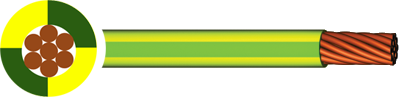
6491B Cable (H07Z-R) - BS7211, LSZH
450/750 Volts · Low Smoke and Zero Halogen (LSZH)
6491B/H07Z-R wiring cable for individual conductors in protected building and equipment wiring. It combines compacted stranded copper with LSZH material at 450/750 V.
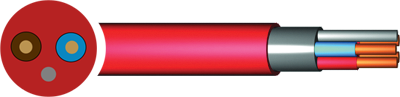
Enhanced Fire Alarm & Security Cable - BS5839, BS7629
300/500V · Low Smoke Zero Halogen (LSZH)
Enhanced fire-alarm and security cable for 300/500 V system wiring. The construction uses mica-tape or silicone-rubber fire-resistant insulation, an aluminium/polyester screen and an LSZH sheath.
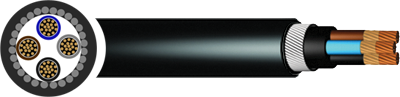
F2 Fire Resistant Mains Cable 1kV - BS7846, BS6387, MGT, XLPE, SWA, LSZH
600/1000 volts · LSZH
F2 fire-resistant mains cable for 600/1000 V power circuits, in sizes from 1.5 to 16 mm². Copper conductors and XLPE insulation are combined with steel-wire armour, LSZH bedding…
Technical References
- IEC — Single-cable flame propagation, IEC 60332-1-2:2025
- IEC — Circuit integrity under fire and shock, IEC 60331-1:2018
- IEC — Smoke measurement, IEC 61034-1
- IEC — Halogen acid gas content, IEC 60754-1
- Prysm Cable — 6491B Cable (H07Z-R) - BS7211, LSZH
- Prysm Cable — Enhanced Fire Alarm & Security Cable - BS5839, BS7629
- Prysm Cable — F2 Fire Resistant Mains Cable 1kV - BS7846, BS6387, MGT, XLPE, SWA, LSZH
Related Reading
XLPE or LSZH? You May Need Both
A building specification can require XLPE insulation and LSZH bedding and sheath in the same cable. XLPE describes the insulation around the conductor; LSZH describes smoke and halogen-related characteristics. An XLPE/PVC cable therefore meets a different material requirement from an XLPE/LSZH cable.
Read MoreWill the Cable Fit the Bend and Survive the Movement?
A cable that can be bent into position is not automatically suitable for repeated machine movement. For a tight route, the useful numbers are the finished cable diameter, the minimum bending radius for that use, and the handling-temperature limit. Conductor class alone cannot answer all three questions.
Read More